Satisfying your required minimum distribution through a direct IRA transfer to a qualified charity allows you to meet IRS mandates while excluding those funds from your taxable income. Utilizing a 2026 QCD RMD checklist helps retirees aged 73 and older reduce their adjusted gross income and maximize tax savings before the year-end deadline.
Waiting until the final weeks of December to address your Required Minimum Distributions often leads to administrative bottlenecks and unnecessary tax exposure. For high net worth retirees, the 2026 fiscal year presents unique challenges in managing Adjusted Gross Income while fulfilling philanthropic goals. A Qualified Charitable Distribution (QCD) serves as a powerful instrument to satisfy your RMD obligations; however, the timing must be precise to ensure the IRS recognizes the gift before the year-end deadline. This guide provides a sophisticated framework for navigating the upcoming season. We will detail a seven step execution checklist, clarify the critical age discrepancy between QCD eligibility and RMD mandates, and examine how these distributions mitigate IRMAA surcharges. Additionally, we will explore specific Arizona tax considerations to ensure your legacy remains protected while your tax liability is minimized.
Why November Is the Critical Month for Your 2026 QCD Strategy
November serves as the functional deadline for retirees seeking to leverage a Qualified Charitable Distribution (QCD) to satisfy their 2026 requirements. While the official IRS cutoff is December 31, waiting until the final weeks of the year introduces significant execution risk. Financial institutions often impose internal processing deadlines in mid-December to account for high seasonal volumes, holiday closures, and potential mail delays.
A distribution that fails to clear the IRA custodian by year-end does not count toward your 2026 obligations. This oversight can trigger a substantial excise tax penalty on the RMD shortfall, currently set at 25 percent, though it may be reduced to 10 percent if corrected promptly. For individuals integrating charitable giving into their retirement income planning, the margin for error is slim. Ensuring the check is issued, mailed, and cashed by the recipient organization is vital for maintaining tax-aware withdrawal strategies.
Proactive planning in November allows you to verify that the first dollars leaving your IRA are the tax-free charitable transfers rather than taxable distributions. To avoid administrative hurdles or the stress of year-end backlogs, following a structured 2026 QCD RMD checklist is the most effective way to secure your tax benefits. A personalized retirement analysis can further clarify how these timelines and processing requirements impact your specific portfolio and legacy goals.
The 2026 QCD RMD Checklist: Seven Essential Steps

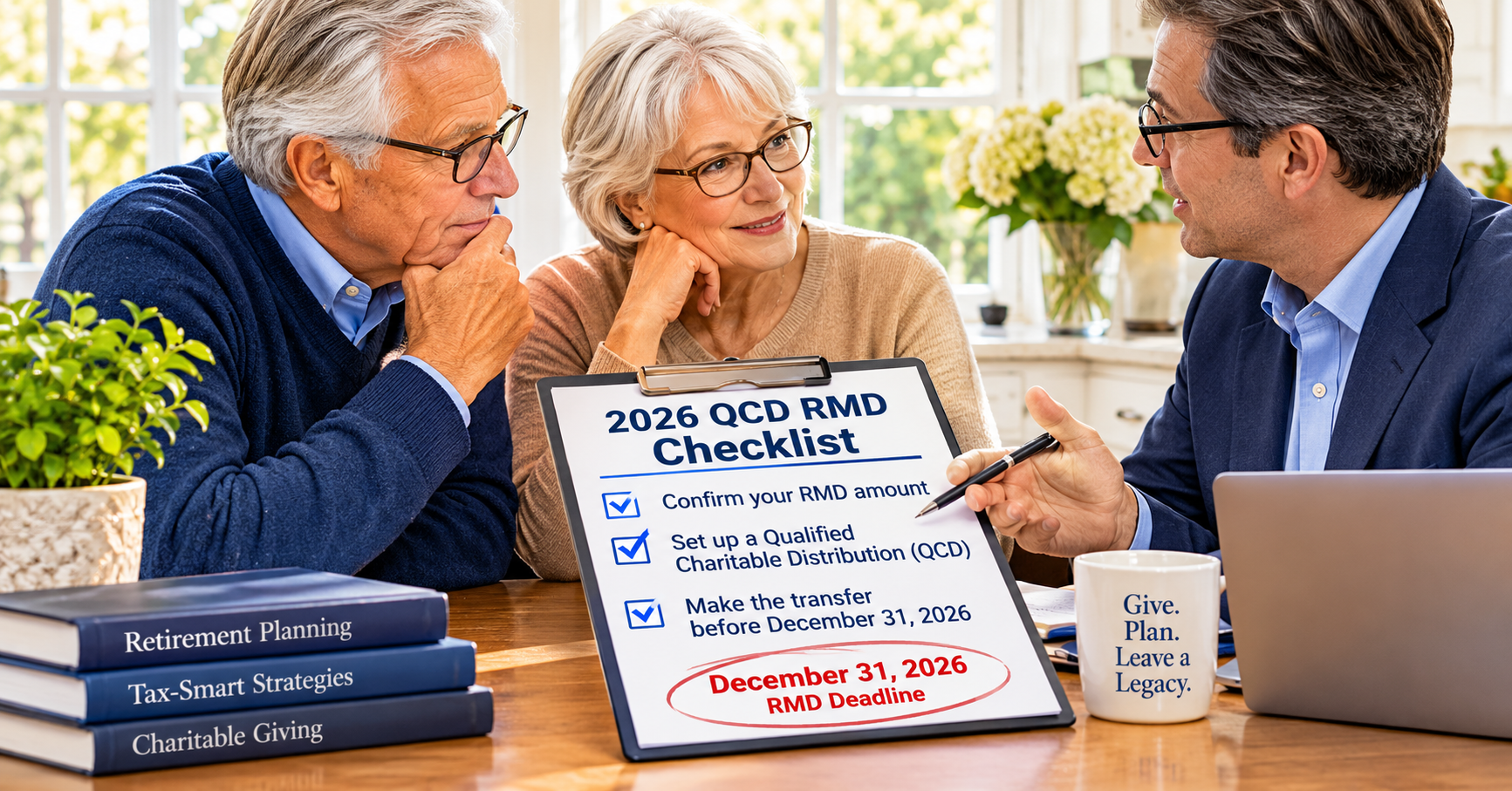
To move from high level strategy to execution, you need a precise 2026 QCD RMD checklist that accounts for both IRS regulations and the operational realities of your financial institution. Following these granular steps ensures your charitable intent results in the intended tax benefits without administrative friction.
Verify your exact RMD amount for 2026. Calculate your total required distribution based on your aggregate IRA balances as of December 31, 2025. This figure serves as the baseline for your retirement income planning; knowing the minimum amount you must distribute allows you to decide how much of that obligation you wish to satisfy through tax-free charitable transfers.
Confirm your age eligibility. The IRS is strict regarding the timing of the distribution. You must be at least 70.5 years old on the day the funds leave your account. Even if you turn 70.5 in the same tax year, a distribution made just one day before your half-birthday will not qualify as a QCD and will instead be treated as taxable income.
Select a qualified 501(c)(3) charity. Not all non-profits are eligible for QCDs. The recipient must be a qualifying public charity. You cannot use a QCD to fund a Donor Advised Fund (DAF), a private foundation, or a supporting organization. Verifying the organization’s status via the IRS Tax Exempt Organization Search tool is a necessary precaution.
Calculate the 2026 QCD limit. The SECURE 2.0 Act indexed the QCD limit for inflation. For the 2026 tax year, the maximum allowable distribution is expected to range between $108,000 and $110,000 per individual. Married couples who both have IRAs can each contribute up to this limit from their respective accounts.
Initiate a Direct Transfer from the IRA custodian. To maintain the tax-exempt status of the gift, the funds must move directly from the custodian to the charity. Do not deposit the money into your personal account first. This process is a cornerstone of tax-aware withdrawal strategies because it prevents the distribution from ever appearing in your Adjusted Gross Income.
Track the check delivery. Many custodians mail the check to the donor, who then forwards it to the charity. If this is the case, use tracked mail to ensure the organization receives and cashes the check well before the December deadline. A check that remains uncashed by year-end may jeopardize your ability to count it toward your 2026 RMD.
Retain the acknowledgment letter. The IRS requires a written acknowledgment from the charity for any gift over $250. This letter must state that no goods or services were provided in exchange for the gift. Unlike standard charitable deductions, the custodian’s 1099-R form will not specifically identify the distribution as a QCD, so this letter is your primary evidence for tax filing.
Understanding the Age Gap: 70.5 for QCDs versus 73 for RMDs
The timing requirements for Qualified Charitable Distributions often create confusion because of the discrepancy between charitable eligibility and mandatory distribution ages. Under the SECURE 2.0 Act, the age to begin Required Minimum Distributions (RMDs) increased to 73 for most individuals. However, the IRS maintains the age for initiating QCDs at exactly 70.5. This two and a half year gap represents a strategic window for retirement income planning.
Using a QCD before you are legally required to take an RMD is a proactive way to manage the long term tax liability of your IRA. Every dollar sent to a charity during this period reduces the total balance of your tax-deferred assets without increasing your taxable income for the current year. Because future RMDs are calculated based on your prior year end account balance, executing QCDs in your early 70s can materially lower the size of your mandated distributions in later years.
This reduction in future income is particularly valuable for mitigating Medicare IRMAA surcharges. These surcharges are tiered based on your Modified Adjusted Gross Income (MAGI). By using this age gap to right size your IRA before the age 73 mandate begins, you may prevent large future RMDs from pushing you into a higher Medicare premium bracket. Integrating these transfers into tax-aware withdrawal strategies allows you to support your community while systematically de-risking your tax profile. A personalized retirement analysis can help determine if the 70.5 to 73 window is the optimal time for you to act on your 2026 QCD RMD checklist.
Tax Benefits Beyond the Donation: Reducing AGI and IRMAA Surcharges

The primary advantage of a QCD lies in its unique ability to bypass your tax return entirely. When you take a standard distribution to satisfy your RMD, that amount is added to your Adjusted Gross Income (AGI). Even if you immediately write a check to a charity and claim a deduction, your AGI has already been inflated. In contrast, a properly executed QCD ensures the funds never touch your personal accounts. This keeps your AGI lower, which is a fundamental goal when following a 2026 QCD RMD checklist.
This distinction creates a powerful ripple effect across your entire financial profile. A lower AGI can reduce the percentage of your Social Security benefits subject to federal income tax. Furthermore, it is a highly effective tool for managing Medicare Income Related Monthly Adjustment Amount (IRMAA) surcharges. For 2026, the IRMAA brackets, which are determined by your income from two years prior, involve strict cliff thresholds. Crossing a threshold by even one dollar can result in significantly higher monthly premiums for Medicare Part B and Part D.
By utilizing tax-aware withdrawal strategies, you can use the QCD to stay below these 2026 IRMAA tiers. For example, if your income is hovering near the projected 2026 base thresholds, which typically begin around $106,000 for individuals or $212,000 for joint filers, a QCD prevents that distribution from triggering a surcharge. This level of retirement income planning protects your monthly cash flow. To see how these income thresholds specifically apply to your household, a personalized retirement analysis can model the impact of charitable distributions on your long term wealth.
Common QCD Pitfalls to Avoid in 2026
Successfully navigating a 2026 QCD RMD checklist requires more than just meeting a deadline; it requires avoiding technical traps that could invalidate the tax benefits. One of the most misunderstood regulations is the first dollars out rule. The IRS stipulates that the first distributions taken from an IRA in a given year are automatically applied to your RMD. If you withdraw funds for personal use early in the year and then attempt a QCD later, you may find you have already satisfied your RMD with taxable income, leaving the QCD as a surplus charitable gift rather than a tax-offsetting strategy. Proper sequencing is essential for effective retirement income planning.
Another frequent error involves the handling of the funds. The distribution must be made payable directly to the qualified 501(c)(3) organization. If the check is made payable to you, even if you immediately endorse it over to a charity, the IRS treats it as a taxable distribution followed by a personal gift. This increases your AGI and nullifies the primary benefit of the QCD.
Pitfall Type | Consequence | Prevention |
|---|---|---|
Ineligible Recipient | Loss of QCD status | Avoid Donor Advised Funds (DAFs) and private foundations. |
Double-Dipping | IRS Audit Risk | Do not claim a charitable deduction for the same funds excluded from income. |
Improper Sequence | Higher Taxable Income | Ensure the QCD occurs before or alongside personal RMD withdrawals. |
Furthermore, the IRS strictly prohibits double-dipping. Since a QCD is excluded from your gross income, you cannot also claim it as an itemized charitable deduction on your tax return. Attempting to do so effectively tries to claim a tax benefit twice on the same dollar, which will trigger a correction during a tax audit. Finally, remember that while Donor Advised Funds (DAFs) are popular for standard giving, they are explicitly excluded from receiving QCDs. For those seeking tax-aware withdrawal strategies, verifying the charity’s status before initiating the transfer is a non-negotiable step. If you are unsure how to sequence these distributions, a personalized retirement analysis can provide a roadmap for your specific accounts.
Arizona Tax Considerations: QCDs and State Tax Credits
Arizona taxpayers in Gilbert face a unique decision when integrating charitable giving into their retirement income planning. While a QCD is a powerful tool for federal tax mitigation, its interaction with Arizona's dollar-for-dollar tax credits requires careful navigation. The state offers generous credits for contributions to Qualifying Charitable Organizations (QCO), Qualifying Foster Care Organizations (QFCO), and Private School Tuition Organizations. However, you cannot claim an Arizona tax credit for a donation made via a QCD because the funds were never included in your taxable income.
For many retirees, the federal tax savings from a QCD outweigh state-level benefits, especially when trying to manage IRMAA tiers or Social Security taxation. Conversely, if your goal is to eliminate your Arizona state tax liability entirely, using cash or after-tax funds for your QCO or tuition credits might be more advantageous. The most effective tax-aware withdrawal strategies often involve a bifurcated approach; using the 2026 QCD RMD checklist to satisfy federal RMD requirements while utilizing separate funds to capture local state credits. Determining the precise balance between these two methods depends on your specific tax bracket and legacy goals. A personalized retirement analysis provides the clarity needed to identify the mathematical sweet spot where you maximize both federal and state advantages.
Planning your Qualified Charitable Distribution now ensures you meet your RMD obligations well before the December rush. This approach allows you to minimize your tax liability while making a positive impact on your community. If you want expert help managing these timelines or aligning your charitable goals with your long-term legacy, we invite you to learn more about our Services. A professional perspective can simplify complex tax rules and help you focus on what truly matters.